Model Architecture
CLOVA Tutor adopts a subject-specific ReAct agent architecture combined with tool-based dialogue orchestration.
This document describes the overall system flow, architecture diagrams for each subject agent, and a detailed reference of the tools used in the pipeline.
Overall Flow
User input first passes through a shared Pre-Pipeline stage.
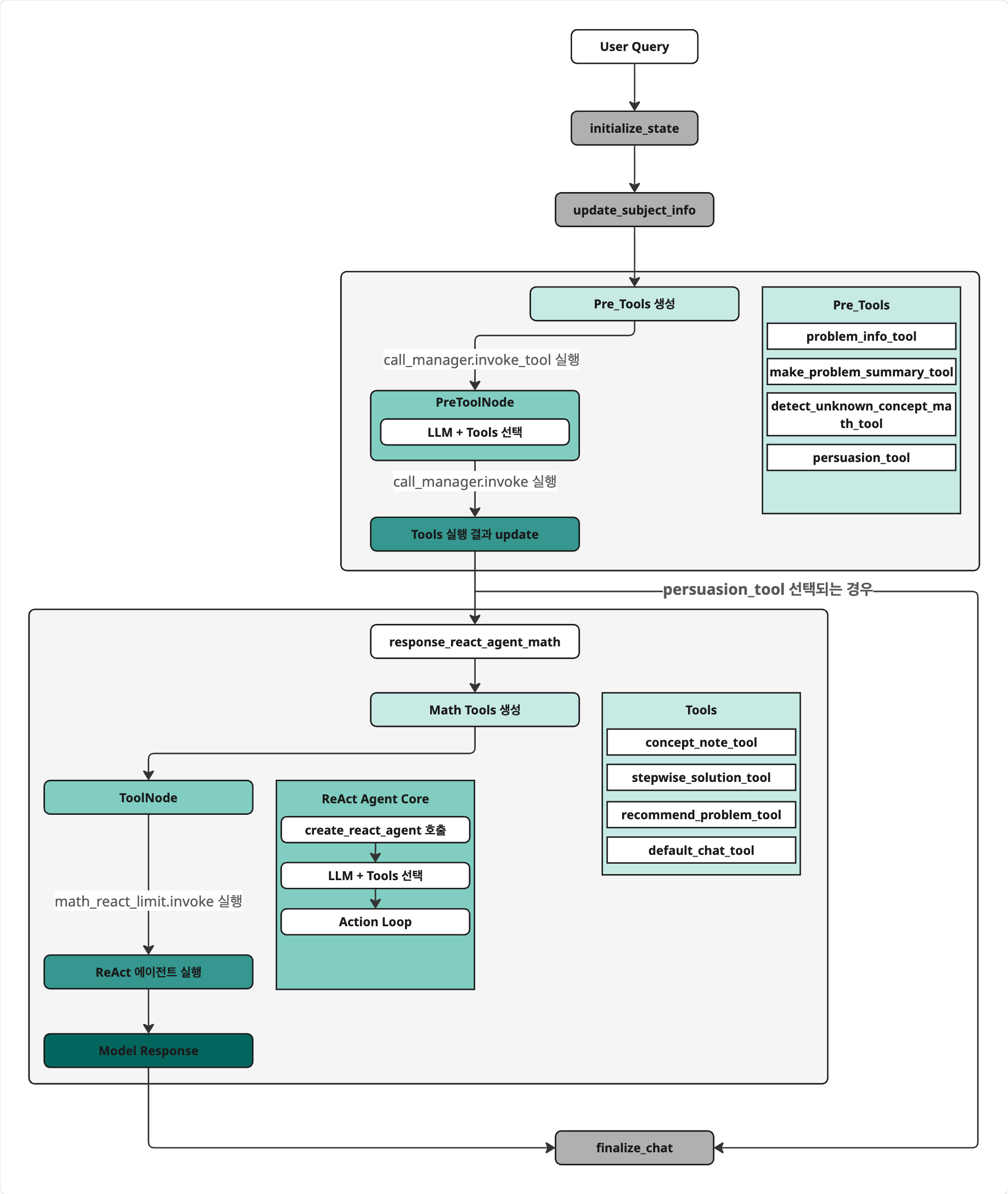
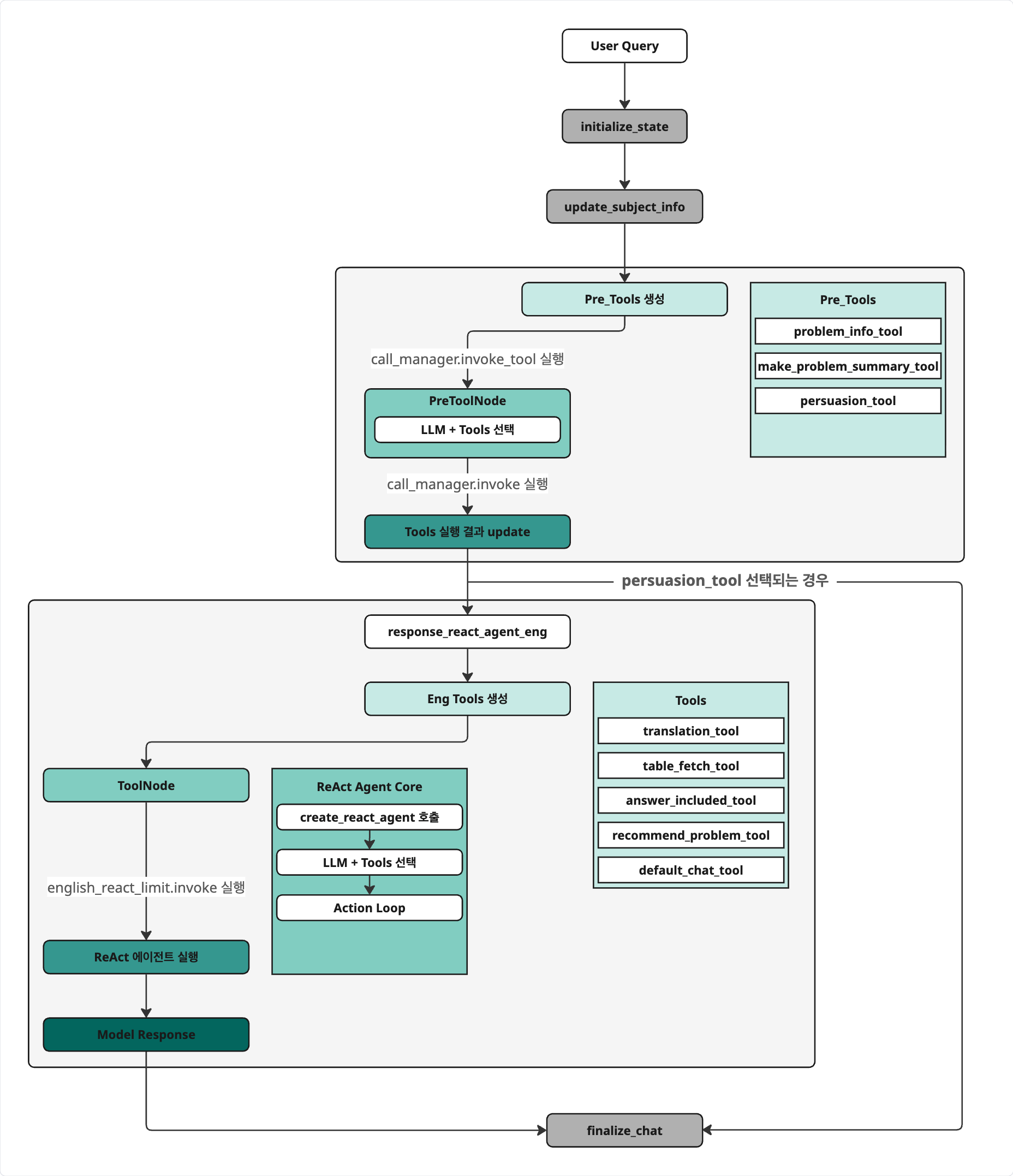
Based on the detected learning subject, the input is then routed to the corresponding ReAct agent (Math or English), where subject-specific reasoning and tool selection take place.
Math ReAct Agent Architecture
English ReAct Agent Architecture
Tool Reference
Common (Pre-Pipeline)
| Subject | Tool | Tool Intent |
|---|---|---|
| Common | problem_info_tool | Called when the user explicitly signals a transition to a new learning unit (problem, topic, word, or question type). Example triggers: "new problem", "different problem", "new topic", "change topic", "what does this mean?", "explain this", "start over", "change the type". |
| Common | persuasion_tool | Used when the conversation deviates from the learning objective and needs to be gently guided back to the original topic. |
| Common | make_problem_summary_tool | Called when a learning interaction has reached a clear problem-level completion and the user requests a summary of the discussion. |
| Math | detect_unknown_concept_math_tool | Triggered when signals of conceptual confusion or insufficient understanding related to a math concept are detected. Example triggers: "what is this?", "explain", "what's the definition?", "I don't get it", "this is hard", "I'm confused", "what's the formula?", "explain the principle", "define the terms". |
Math — ReAct Agent
| Subject | Tool | Tool Intent |
|---|---|---|
| Math | concept_note_tool | Used when the user asks about a specific math concept. Example triggers: "define this", "what are the conditions?", "what properties does it have?", "summarize the formula", "explain the concept". |
| Math | stepwise_solution_tool | Used when the student intends to solve the problem step by step with guidance. Example triggers: "show me how to solve it", "let's solve it together", "what's the answer?", "where did I go wrong?". Note: This tool is intended for guided problem-solving. For concept-only explanations, use concept_note_tool. |
| Math | recommend_problem_tool | Called when either (1) the student explicitly requests a new problem recommendation, or (2) the student's response is judged to be correct. Whenever possible, correctness is verified objectively (e.g. arithmetic validation). The tool is called only on strong affirmative signals. Uncertain phrasing lowers decision confidence, and the tool must not be called in cases of clear mismatch or explicit negation. If incorrect-answer signals are detected, demonstrate_solution_tool is used instead. |
| Math | default_chat_tool | Handles off-topic or non-math-related queries. |
English — ReAct Agent
| Subject | Tool | Tool Intent |
|---|---|---|
| English | translation_tool | Used when the user requests translation or interpretation. |
| English | table_fetch_tool | Used when vocabulary or grammar information is requested. |
| English | answer_included_tool | Used when the user asks for an explanation of an English problem or exercise. |
| English | recommend_problem_tool | Called when either (1) the student requests a new problem recommendation, or (2) the student's response is judged to be correct. |
| English | default_chat_tool | Handles off-topic or non–English-learning queries. |